
Responsible Use
What Reverse Face Search Can—and Cannot—Tell You
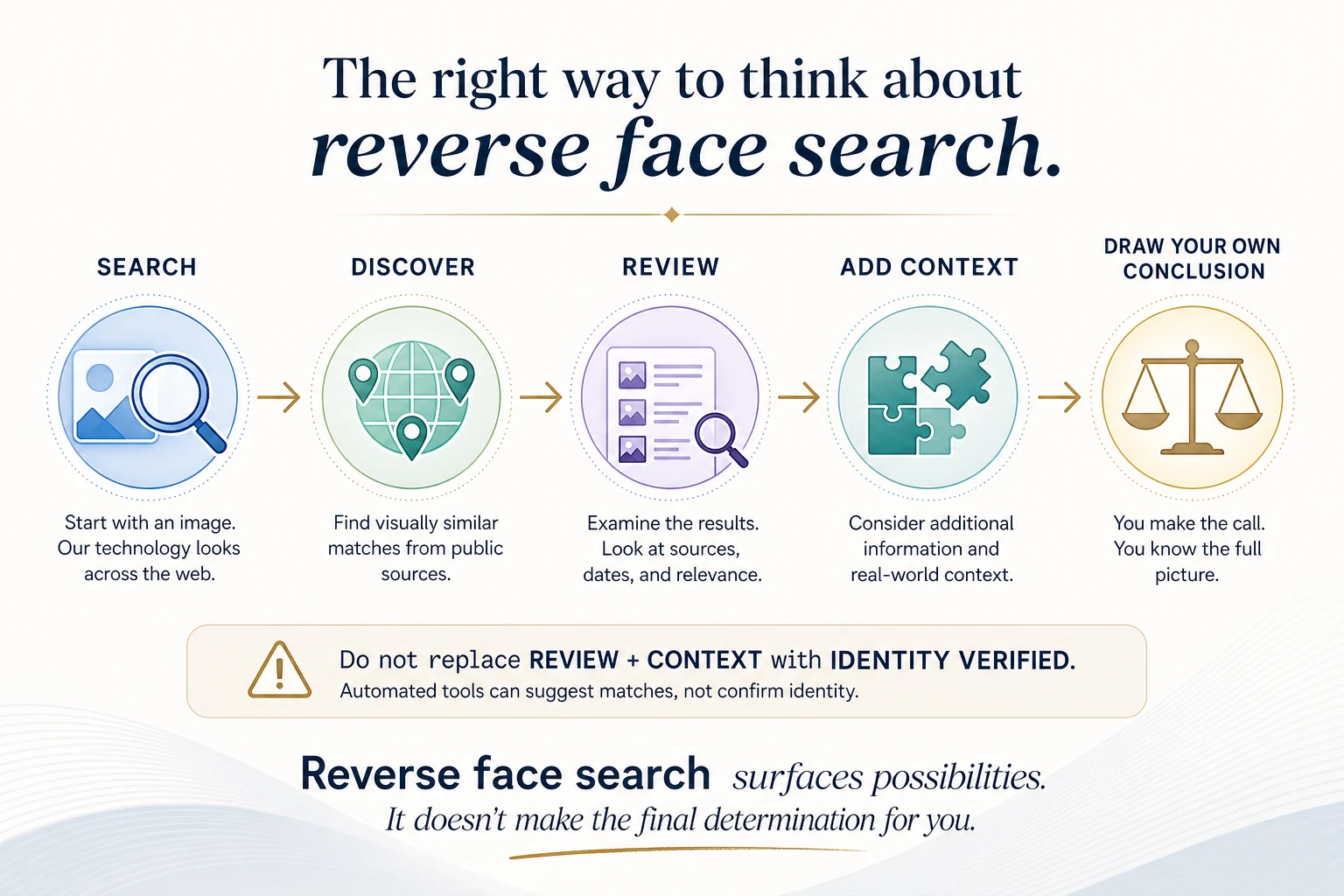
Reverse face search can surface visually similar public images and useful source context, but it has important limits. Here's what a result can tell you — and what it cannot.
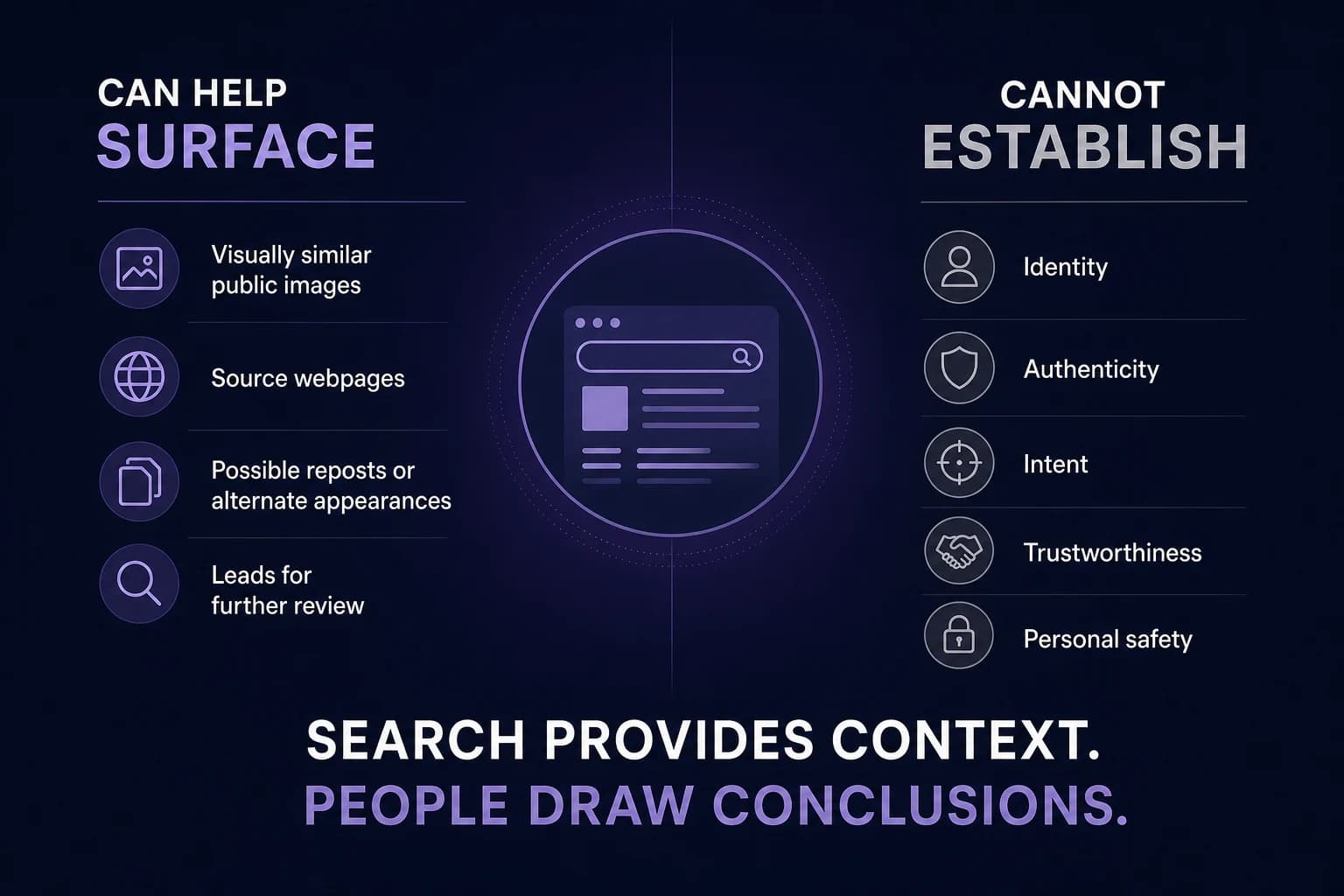
Face search can give you leads. It cannot give you certainty.
Reverse face search can help uncover publicly indexed photographs containing a visually similar face.
That can be useful when you're trying to understand where your own photos appear online, discover alternate photographs, trace a public image footprint, or find source pages worth reviewing.
But a face-search result is not an identity certificate.
It does not automatically tell you who a person is, whether information attached to an image is accurate, whether an account belongs to them, or whether they are trustworthy.
And when nothing appears, that doesn't prove nothing exists.
The easiest way to use reverse face search responsibly is to understand exactly what the technology is capable of telling you — and where its conclusions stop.
What reverse face search actually does
At a high level, reverse face search starts with a photograph containing a face.
The system detects and processes the face, creates a numerical representation for comparison, and searches against other facial representations available in its searchable resources.
Potential candidates are then ranked according to visual similarity.
That means the technology is fundamentally answering a question like:
“Which indexed faces appear most visually similar to the face I searched?”
It is not directly answering:
“Who is this person?”
Those may sound like similar questions, but they're not.
One produces candidate images.
The other requires a much broader identity determination.
For the technical pipeline, see How Reverse Face Search Works.
What face search CAN tell you
1. That a visually similar face appears in a searchable image
This is the most basic conclusion.
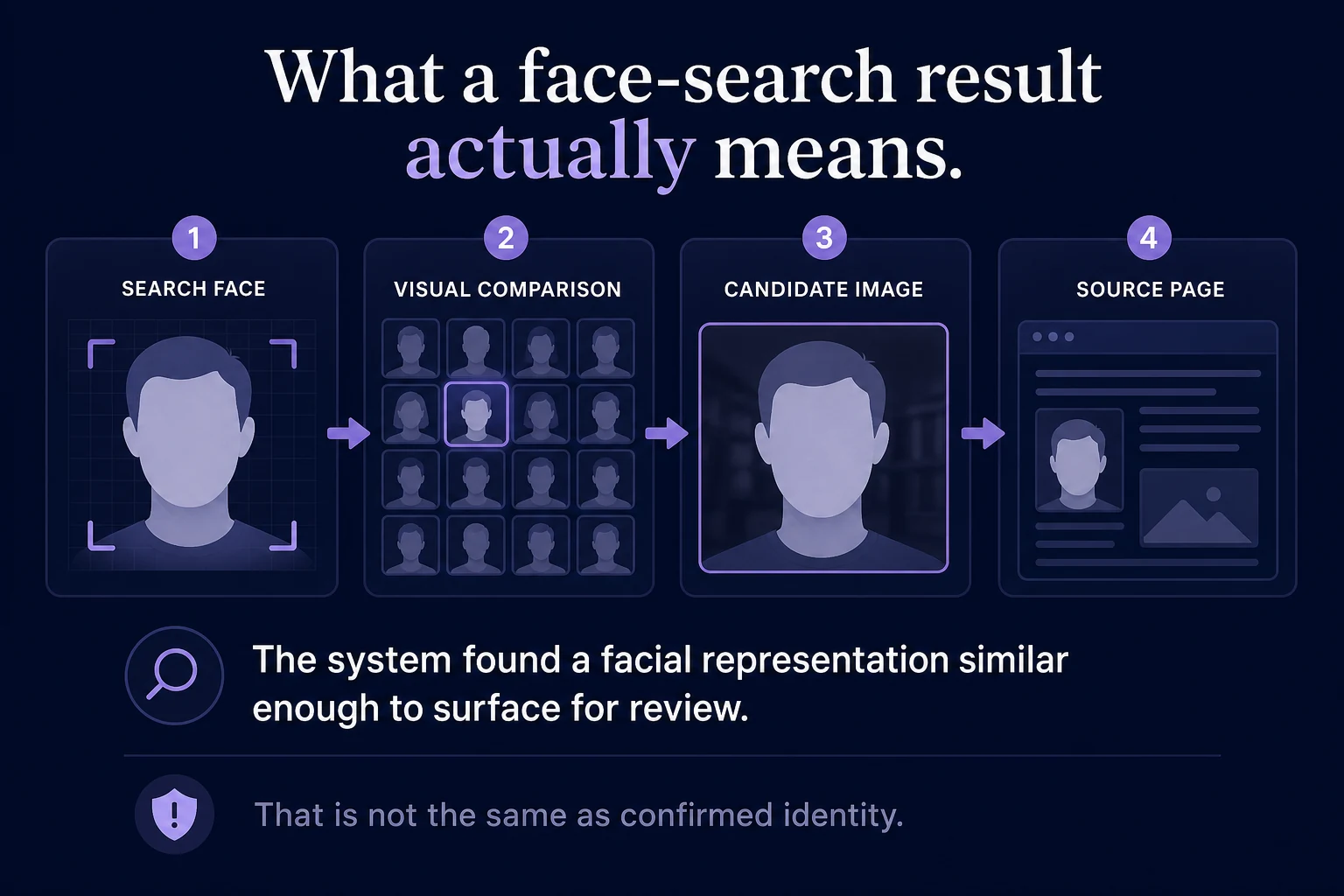
If a result appears, the search system found a facial representation sufficiently similar to surface according to its own comparison and ranking process.
That's useful.
It gives you something concrete to review.
But the wording matters:
The system found a visually similar face.
Not:
The system proved this is the same person.
2. Where that image appeared
This is one of the most useful parts of visual search.
A result can lead you to a public source page where the image was found.
That page may help answer:
What website published the image?
What context surrounds it?
Is a name attached?
Is it part of an article?
Is it a public profile image?
Does the page appear old or recent?
Is the image still live?
This context often matters more than the thumbnail alone.
A face match without a source tells you very little.
A source page gives you something to investigate.
3. That the same face may appear across different photographs
Unlike conventional reverse image search, face search is designed to compare the face rather than requiring the photographs themselves to be copies.
That means it may surface:
a different pose;
different lighting;
another hairstyle;
a different background;
an older photograph;
a cropped image;
an entirely different photo session.
That's where reverse face search becomes useful for exploring a public visual footprint.
See Reverse Face Search vs. Reverse Image Search for the full distinction.
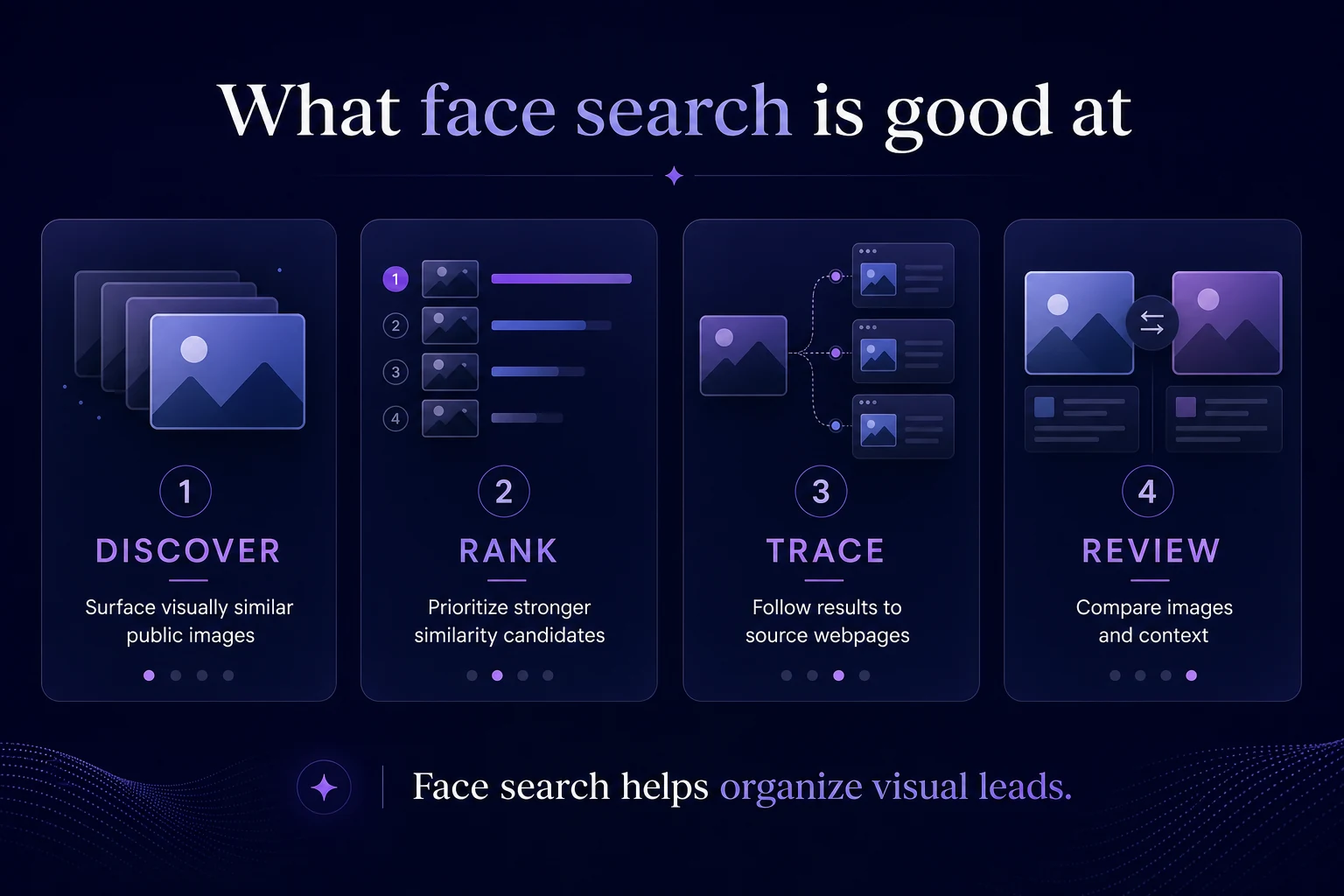
4. Which candidates the system considers more visually similar
Similarity scores or categories can help rank results.
That lets you review stronger candidates first rather than treating every image equally.
But the score is primarily a ranking aid.
A higher similarity score does not automatically equal a higher statistical probability of identity.
Read What Does a Face Similarity Score Mean?.
What reverse face search CANNOT tell you
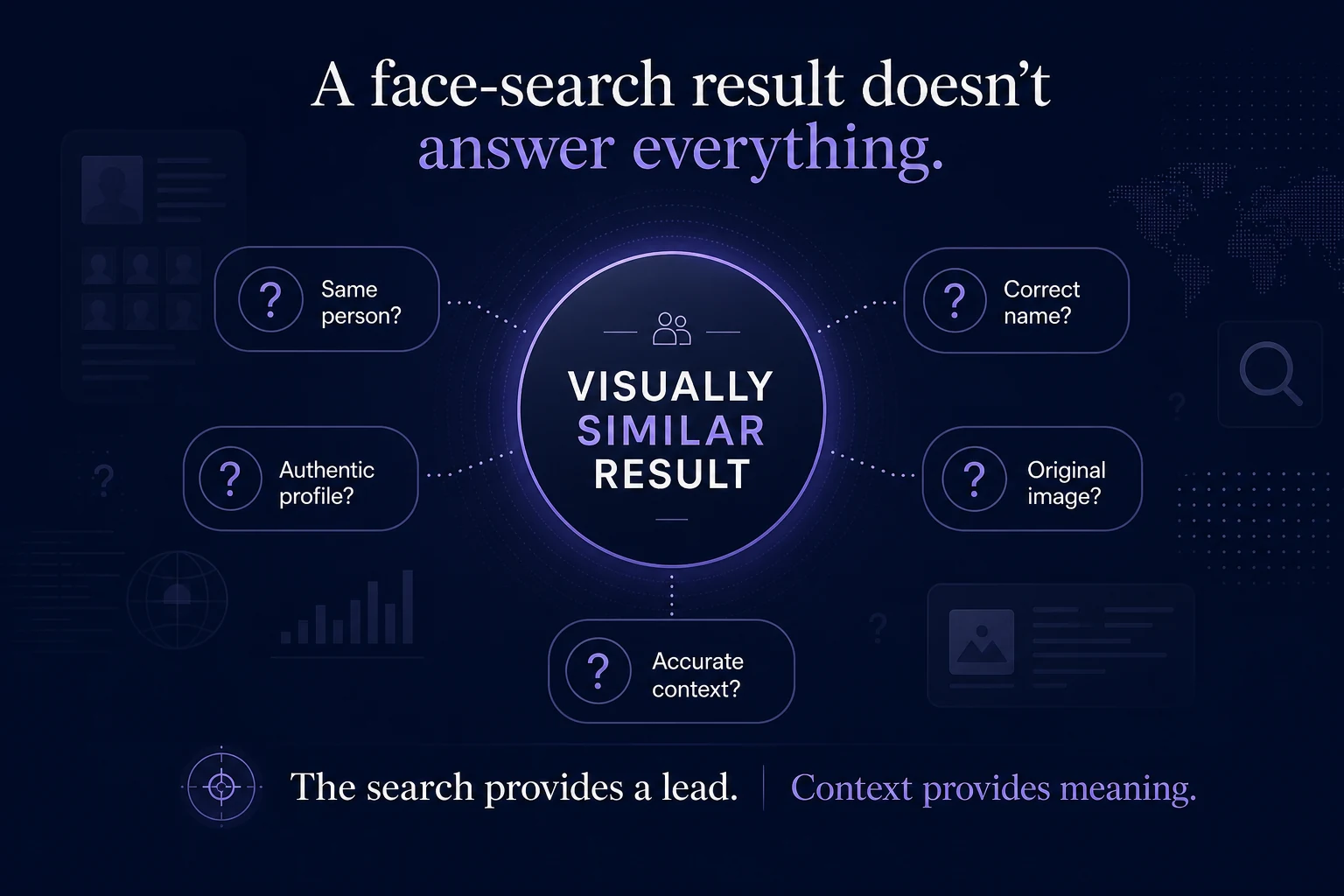
1. It cannot confirm identity by itself
A visually similar result is not the same thing as verified identity.
Two different people can look alike.
Images can be mislabeled.
Profiles can contain incorrect information.
A photograph can be reposted into the wrong context.
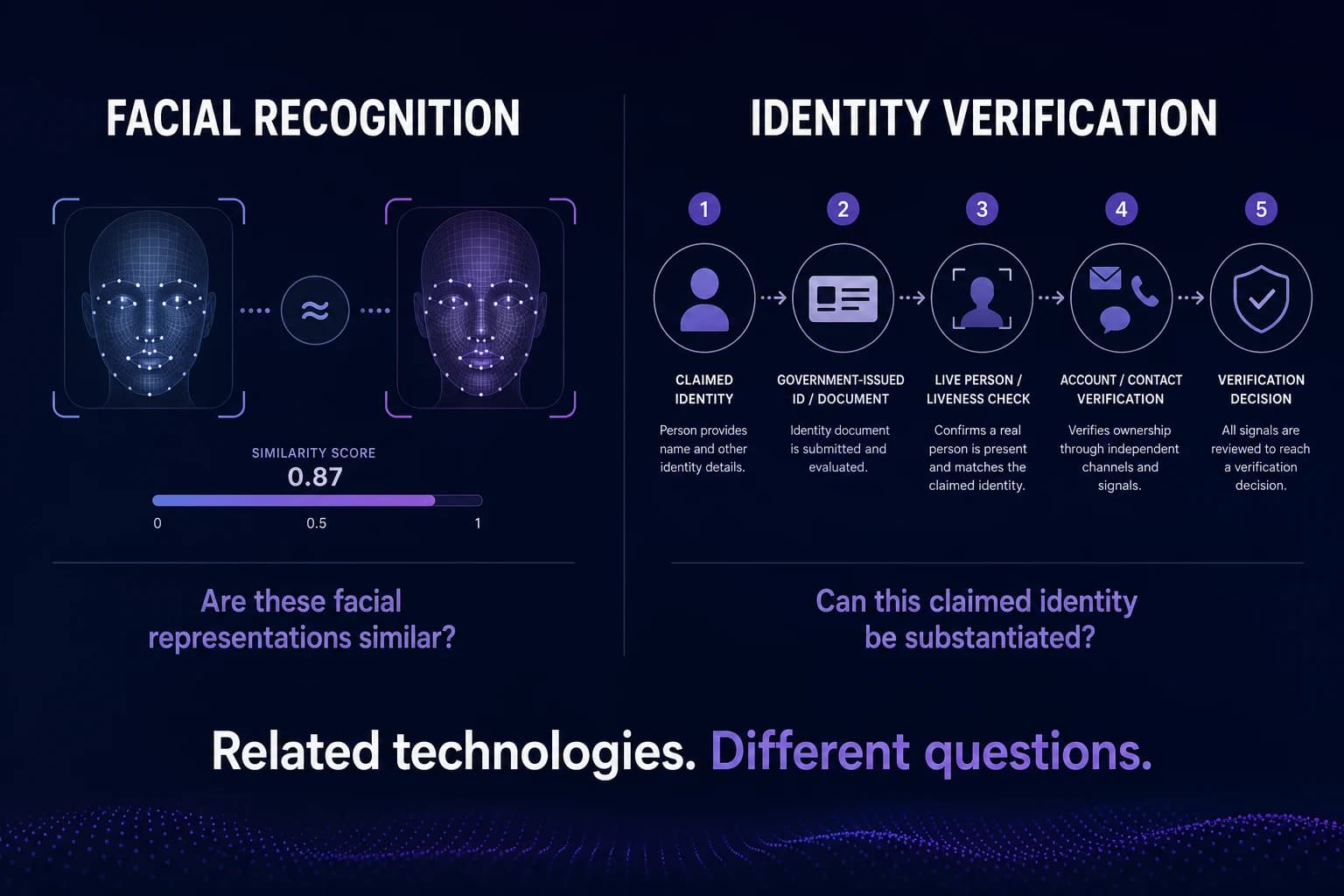
Facial recognition compares appearance.
Identity verification requires additional evidence.
See Facial Recognition vs. Identity Verification.
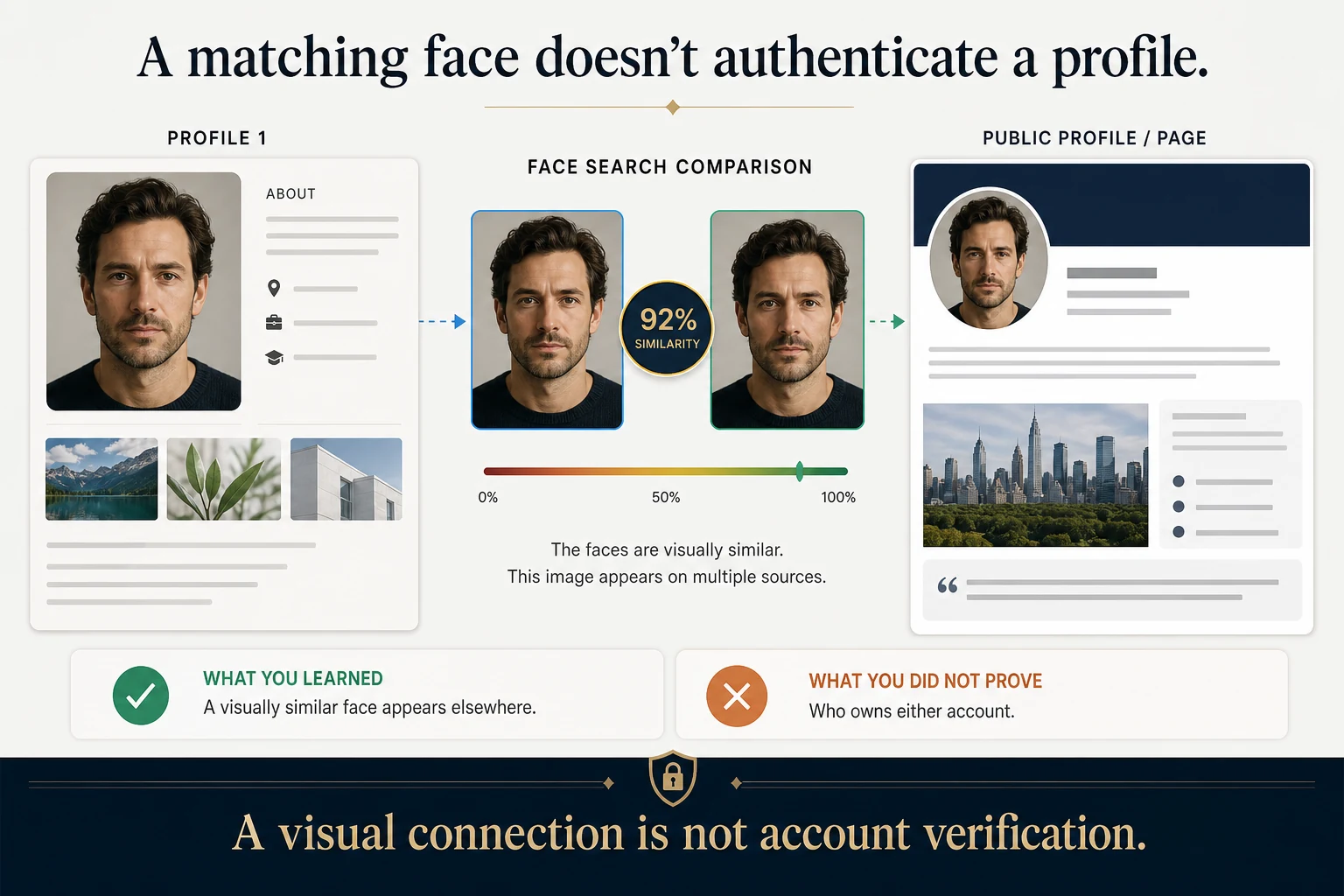
2. It cannot prove a profile is authentic
Suppose you search a profile photo and find another image of a visually similar face.
That may be useful context.
But it doesn't automatically tell you:
who created either account;
who controls either account;
whether names are accurate;
whether one image was copied from another;
whether either account is genuine.
Face search can help you discover connections worth reviewing.
It cannot independently authenticate a profile.
3. It cannot tell you whether someone is trustworthy
This one needs to be explicit.
A face-search result cannot determine someone's character, intentions, honesty, reliability, or trustworthiness.
Even finding nothing concerning doesn't establish those things.
Likewise, finding a photograph on an unexpected page doesn't automatically mean something concerning has happened.
Context matters.
Search is discovery.
Judgment comes afterward.
4. It cannot tell you whether interacting with someone is safe
Reverse face search is not a personal-safety assessment.
A search that returns no results does not mean:
"This person is safe."
A search that returns results does not mean:
"This person is dangerous."
Those conclusions require information far beyond facial similarity.
This is exactly why CatchAFace does not position a face-search result as proof of personal safety.
5. It cannot prove an image is real
Finding another image of a similar face does not automatically tell you whether the source photograph is:
genuine;
manipulated;
AI-generated;
edited;
mislabeled;
taken from another context.
Those are separate analysis problems.
Reverse face search can sometimes reveal useful context around an image.
It is not, by itself, an image-authenticity detector.
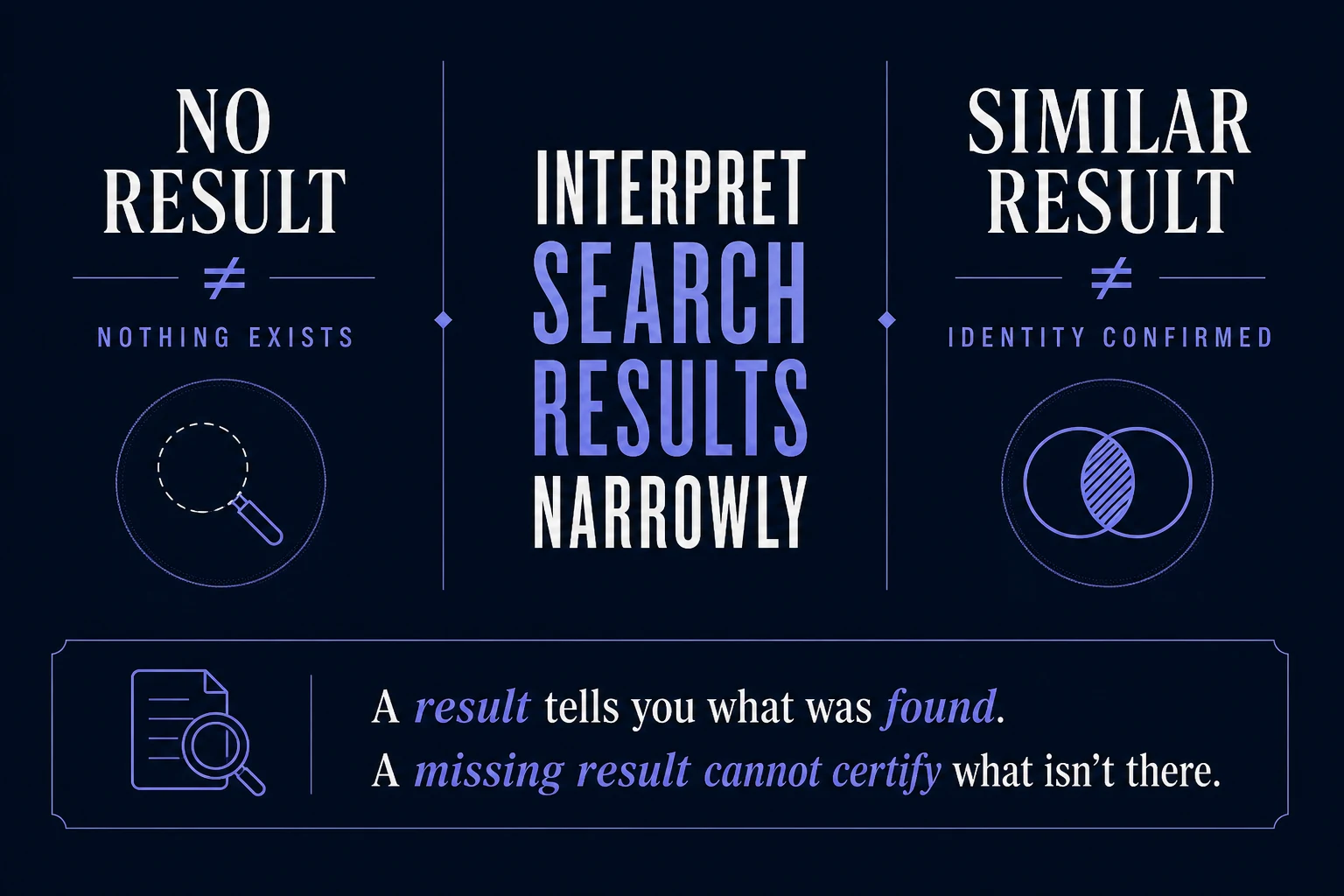
6. It cannot tell you that nothing exists
This is the other huge misunderstanding.
If a search returns no results, you cannot conclude:
"There are no other photos of this face online."
A relevant photo might exist outside the searchable index.
It may not have been crawled.
It may be private or restricted.
It may be too new.
The search provider may not cover that source.
The uploaded photo may also be difficult to compare.
So the correct interpretation of zero results is much narrower:
The search did not return a qualifying candidate from what it searched.
Read No Face Search Results? What That Actually Means.
Search coverage creates hard limits
Even the best recognition technology can't search an image it doesn't have access to.
That's worth repeating.
Imagine a perfect face-recognition model.
Somewhere online is another photograph showing the searched person.
But that image isn't available to the searchable index.
The search returns nothing.
The recognition model didn't necessarily fail.
The coverage did.
This is why face-search performance is partly a recognition problem and partly an indexing problem.
See How Accurate Is Reverse Face Search?.
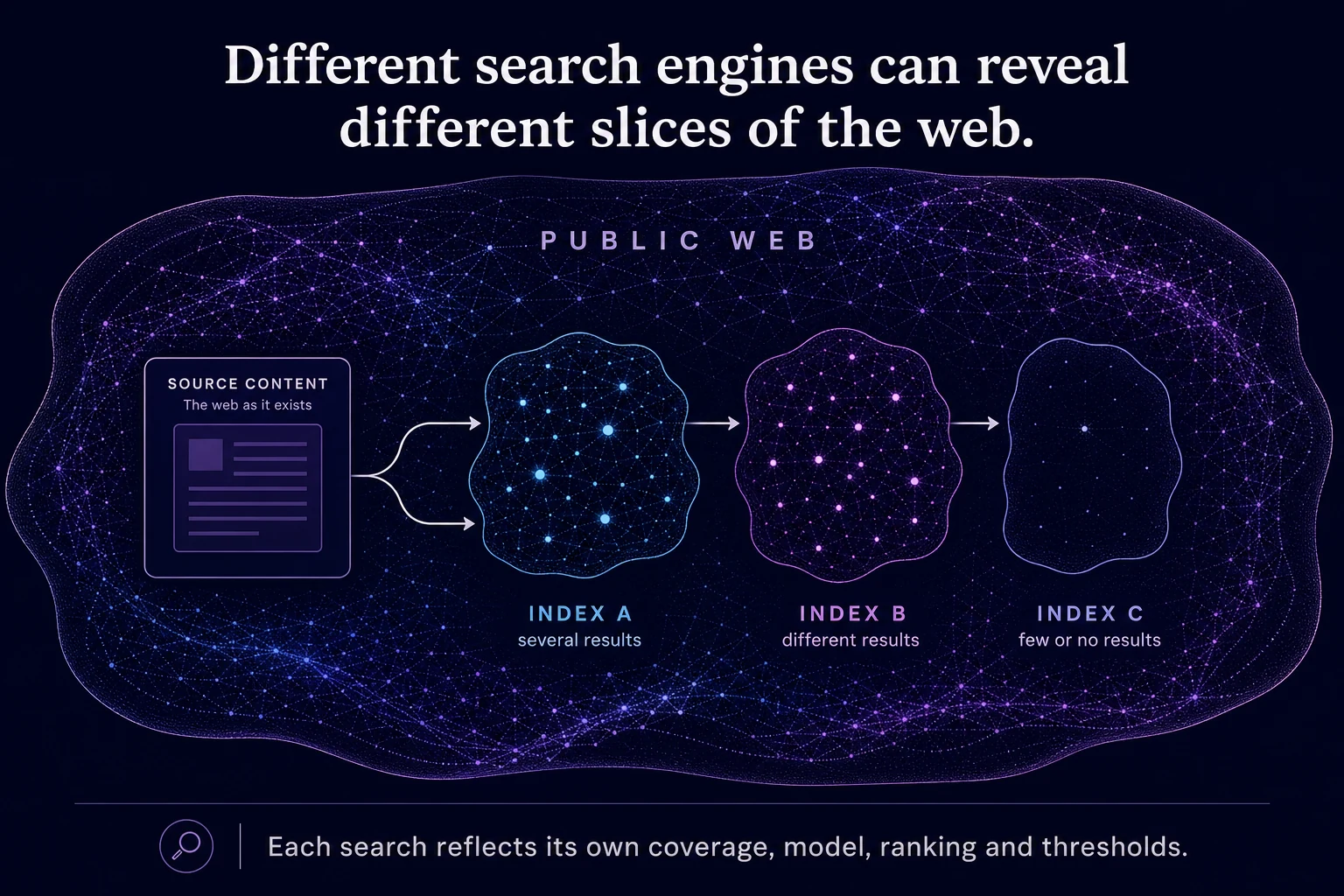
Different search engines can tell you different things
Two providers can receive the same source photograph and produce very different result sets.
That doesn't necessarily mean one provider has dramatically better facial-recognition technology.
Their indexes may simply contain different images.
Their thresholds may differ.
Their ranking methods may differ.
Their crawling and filtering policies may differ.
So one search should never be treated as a universal statement about what's available online.
See Best Reverse Face Search Engines in 2026.
A result should lead to questions, not conclusions
When you find an interesting result, ask:
Does the face genuinely resemble the search image?
What source page contains it?
What does the surrounding page actually say?
Is the image attributed to anyone?
Could this be a lookalike?
Could the image be reposted or mislabeled?
Does another source support the same conclusion?
That approach turns face search into what it works best as:
a discovery tool.
Quick reference: Can face search tell me this?
Question | Can face search answer it? |
|---|---|
Where does a visually similar face appear publicly? | It can help |
Which candidates are more visually similar? | It can help |
Where was a candidate image found? | Often, yes |
Are these definitely the same person? | No |
What is someone's legal identity? | No |
Is a profile authentic? | No |
Does someone own a particular account? | No |
Is someone trustworthy? | No |
Is someone safe to interact with? | No |
Does no result mean no image exists? | No |
Can it remove the source image from a website? | No |
Treat face search as discovery, not certainty
Reverse face search can be extremely useful when its role is understood correctly.
It can surface visually similar images.
It can help you find source pages.
It can rank candidates.
It can reveal public visual connections you may not have known existed.
But it cannot independently establish identity, authenticate a profile, judge someone's intentions, determine personal safety, or prove that nothing exists when a search comes back empty.
The simplest way to remember the boundary is:
Face search can tell you what it found. It cannot tell you everything that result means.
Related Articles
Privacy
How to Remove Your Face From Reverse Face Search Engines
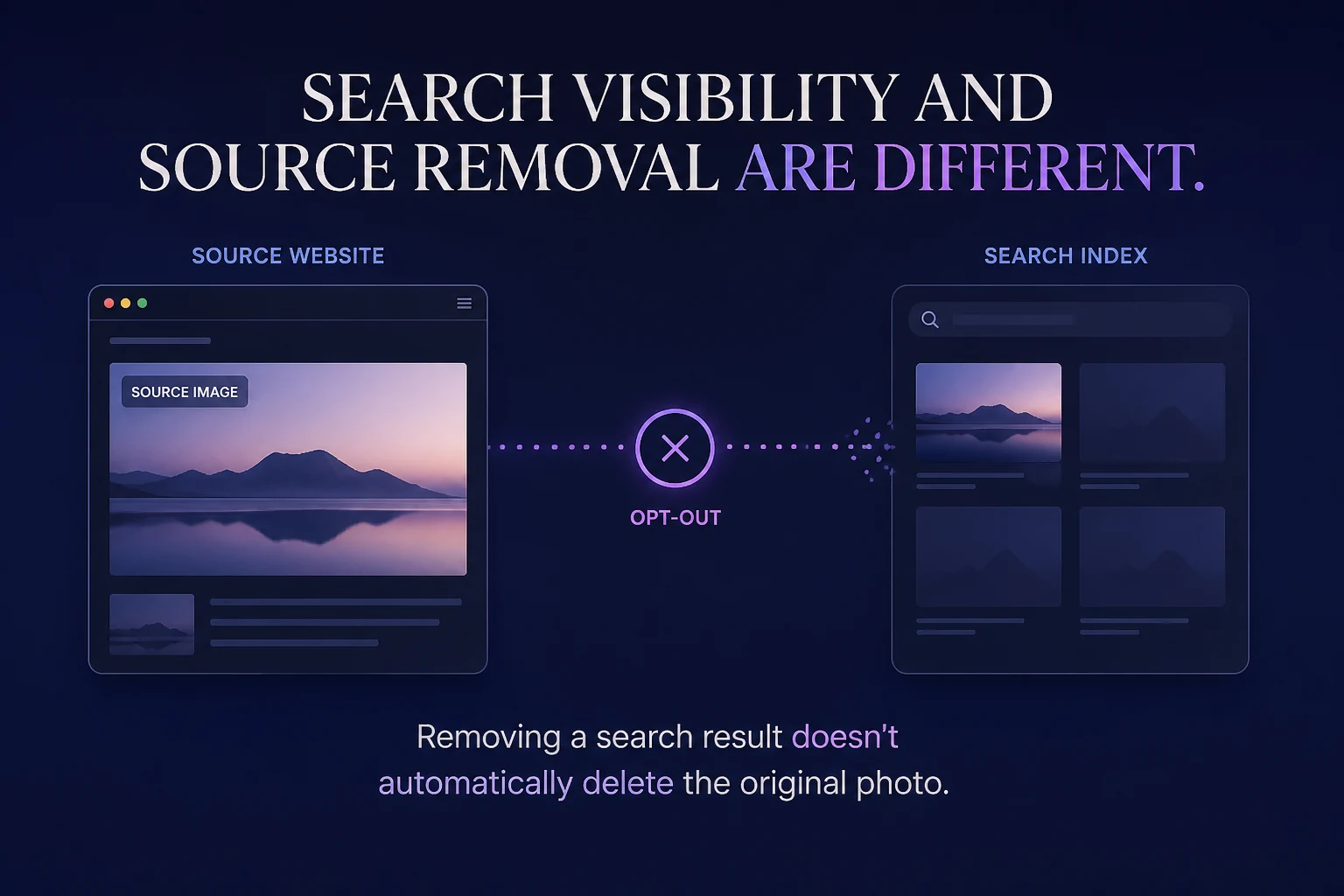
Reverse face-search engines don't all use the same opt-out process. Learn how facial-search removal works, what an opt-out actually removes, and why the original image may require separate action.
11 min read
Face Search
Facial Recognition vs. Identity Verification
Facial recognition and identity verification are often treated as the same thing. They aren't. Learn what each technology actually does — and why a face match by itself does not confirm identity.
6 min read
Face Search
How Accurate Is Reverse Face Search?
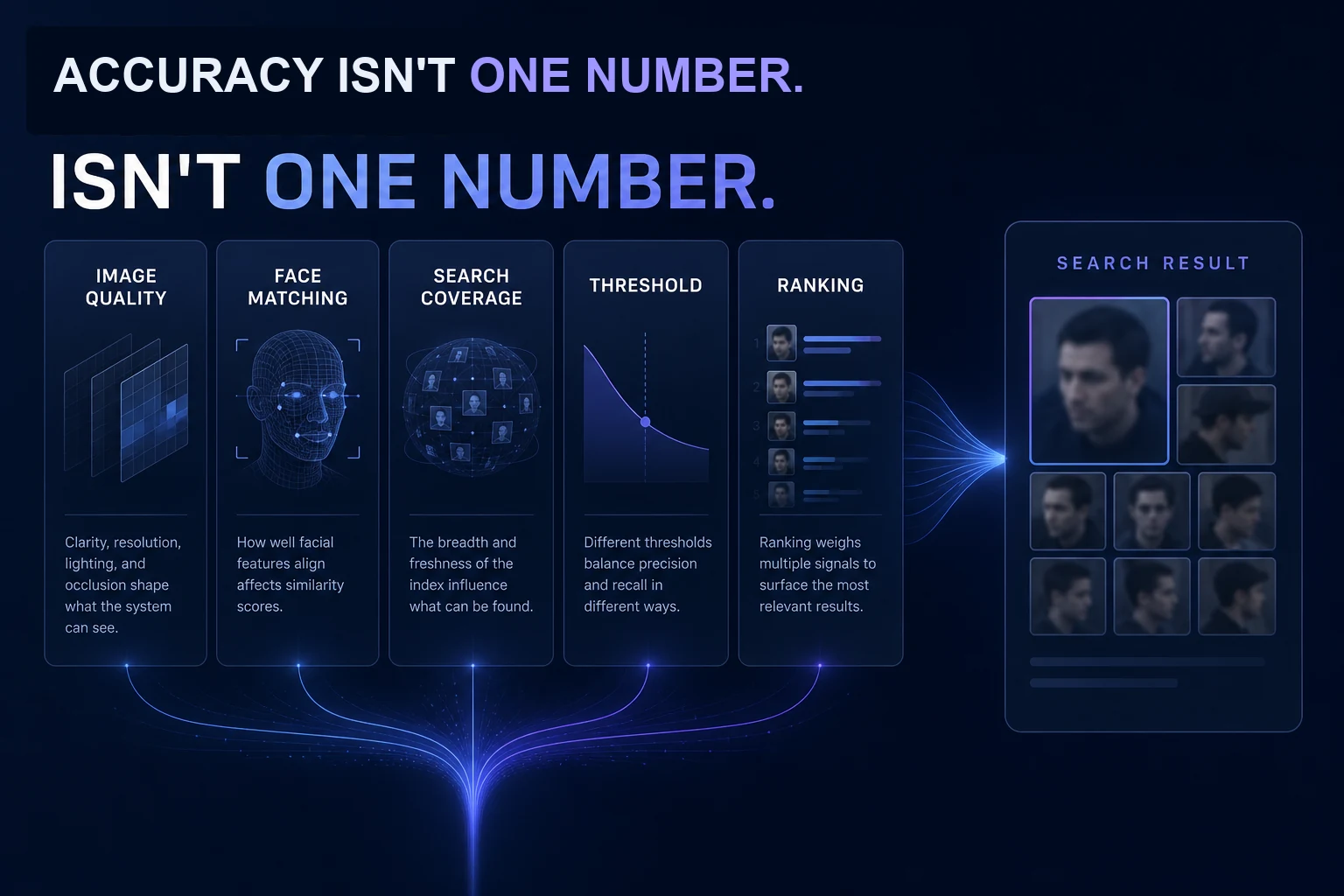
Modern facial recognition can be remarkably capable, but reverse face search accuracy isn't one simple percentage. Image quality, pose, thresholds, search coverage, and false matches all affect what you actually see.
7 min read