
Face Search
How Accurate Is Reverse Face Search?
Modern facial recognition can be remarkably capable, but reverse face search accuracy isn't one simple percentage. Image quality, pose, thresholds, search coverage, and false matches all affect what you actually see.
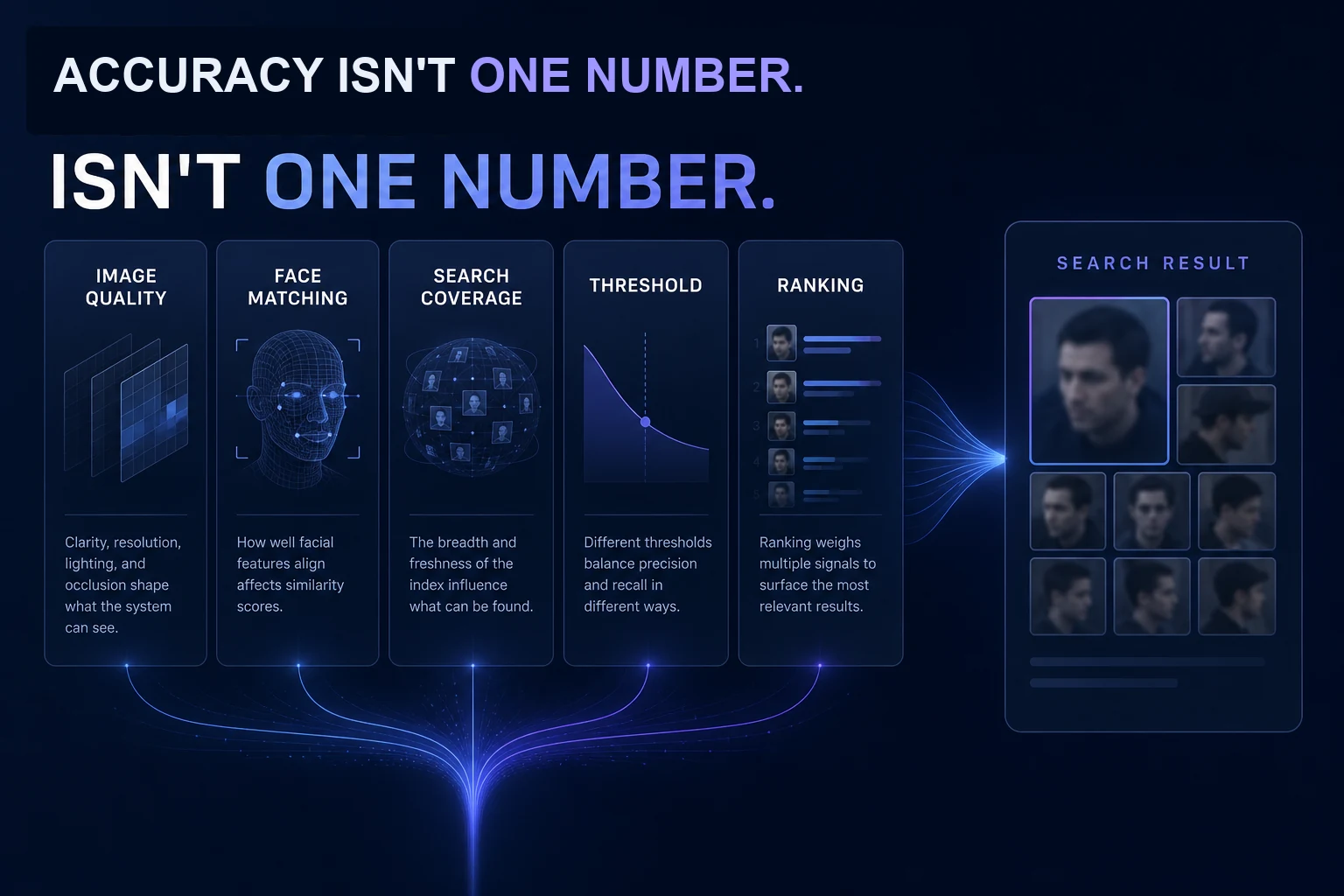
There's no single percentage that answers that question.
Modern facial-recognition technology can compare faces across different photographs with impressive accuracy under the right conditions.
But reverse face search introduces a much bigger problem than simply asking whether a recognition model can distinguish two faces.
The system also has to:
find useful images to search;
detect the face;
create a useful facial representation;
compare it against potentially enormous numbers of candidates;
decide which candidates are similar enough to surface;
and rank those results usefully.
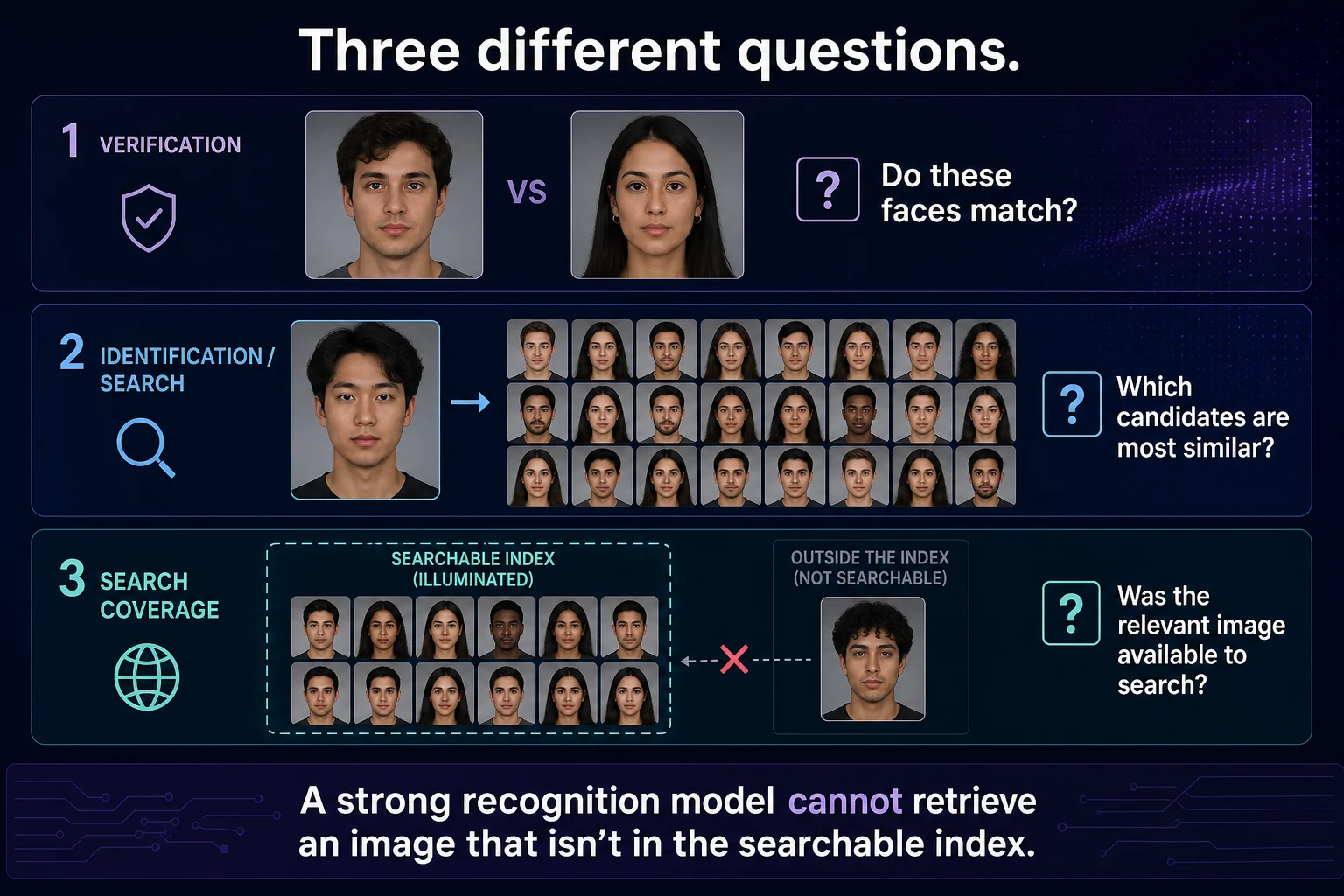
And even a perfect recognition model couldn't return a photograph that isn't available in its searchable index.
So when someone asks:
"How accurate is reverse face search?"
the better question is:
"Accurate at which part of the process?"
Face recognition and face search aren't exactly the same problem
This distinction is fundamental.
A facial-recognition model can be evaluated on a controlled task such as:
Do these two photographs show the same person?
That's essentially a facial verification problem.
Reverse face search asks something more like:
Among all these indexed faces, which ones are most similar to the face I provided?
Now the system isn't comparing only two photographs.
It's searching potentially enormous numbers of candidates.
And then there's another layer:
Does the searchable collection even contain the photograph we're hoping to find?
Those are separate problems.
Modern face recognition can be extremely capable
There's a reason facial recognition has become useful.
Modern deep-learning models don't simply measure the distance between someone's eyes and nose. They learn numerical facial representations — often called embeddings — designed so photographs with similar facial identity characteristics can be compared mathematically.
That allows recognition systems to tolerate differences such as:
expression;
lighting;
moderate changes in angle;
hairstyle;
facial hair;
some effects of aging;
different cameras and backgrounds.
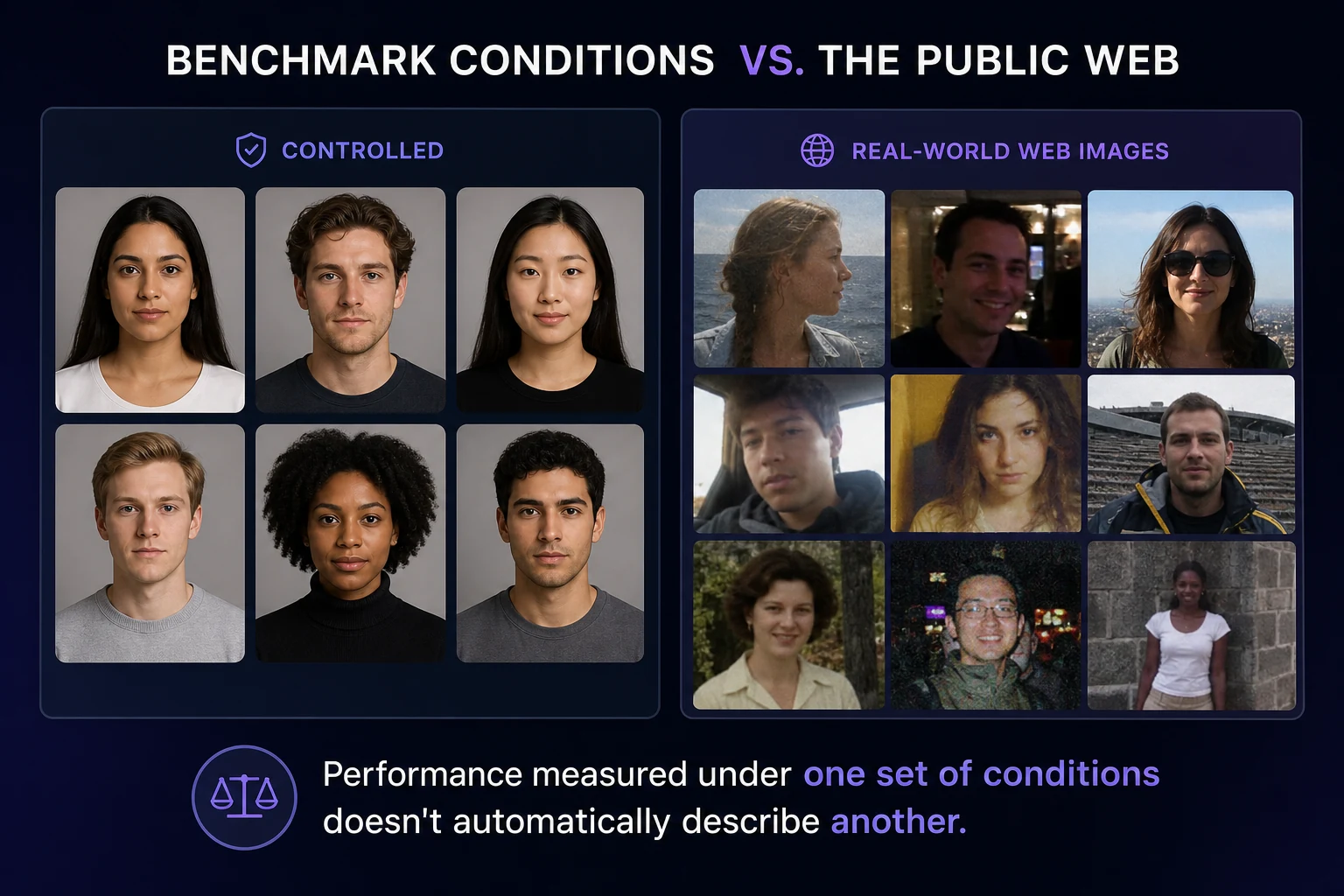
Controlled benchmarks can produce extremely high performance for leading algorithms. NIST's ongoing Face Recognition Technology Evaluation (FRTE) work documents how algorithms perform under carefully specified conditions — see the FRTE 1:1 verification overview.
But here's the mistake:
Benchmark accuracy is not the same thing as saying “reverse face search is X% accurate on the internet.”
Real-world search photographs can be blurry, compressed, tiny, badly lit, partially obstructed, taken years apart, or captured from difficult angles. NIST specifically notes that false negatives are strongly dependent on image quality.
The biggest factors affecting face-search accuracy
1. Image quality
A recognition system can only work with information contained in the photograph.
Blur can erase detail.
Extremely low resolution can reduce usable facial information.
Poor exposure can conceal features.
Heavy compression can introduce artifacts.
That doesn't mean every imperfect photograph fails. It means increasingly poor input can make matching more difficult.
NIST's FRTE guidance identifies inadequate exposure and pose-related capture problems as factors that can increase false-negative rates.
For practical advice, see What Makes a Good Photo for Reverse Face Search?.
2. Pose and obstruction
A mostly frontal photograph exposes more of the face to the recognition model than an extreme profile.
Similarly, sunglasses, masks, hands, hair, shadows, or other obstructions can hide useful information.
Modern models are designed to tolerate variation, so this isn't:
frontal = works
angled = fails
It's a continuum.
As the amount or quality of useful facial information decreases, the comparison generally becomes more challenging.
3. Changes over time
Faces change.
A photograph taken this year and one taken fifteen years ago aren't identical representations of someone's appearance.
Recognition systems can be surprisingly robust to aging, but age introduces another source of variation alongside hairstyle, weight, facial hair, skin changes, and other differences.
This is why searching with both an older and newer source photograph can sometimes be useful when you're investigating your own long-term public image footprint.
4. The recognition model
Not every face-recognition model works the same way.
Different neural networks can be trained on different datasets, with different architectures, objectives, and optimization methods.
They may also generate different facial embeddings.
So two face-search services looking at the same pair of photographs don't necessarily have to produce exactly the same similarity assessment.
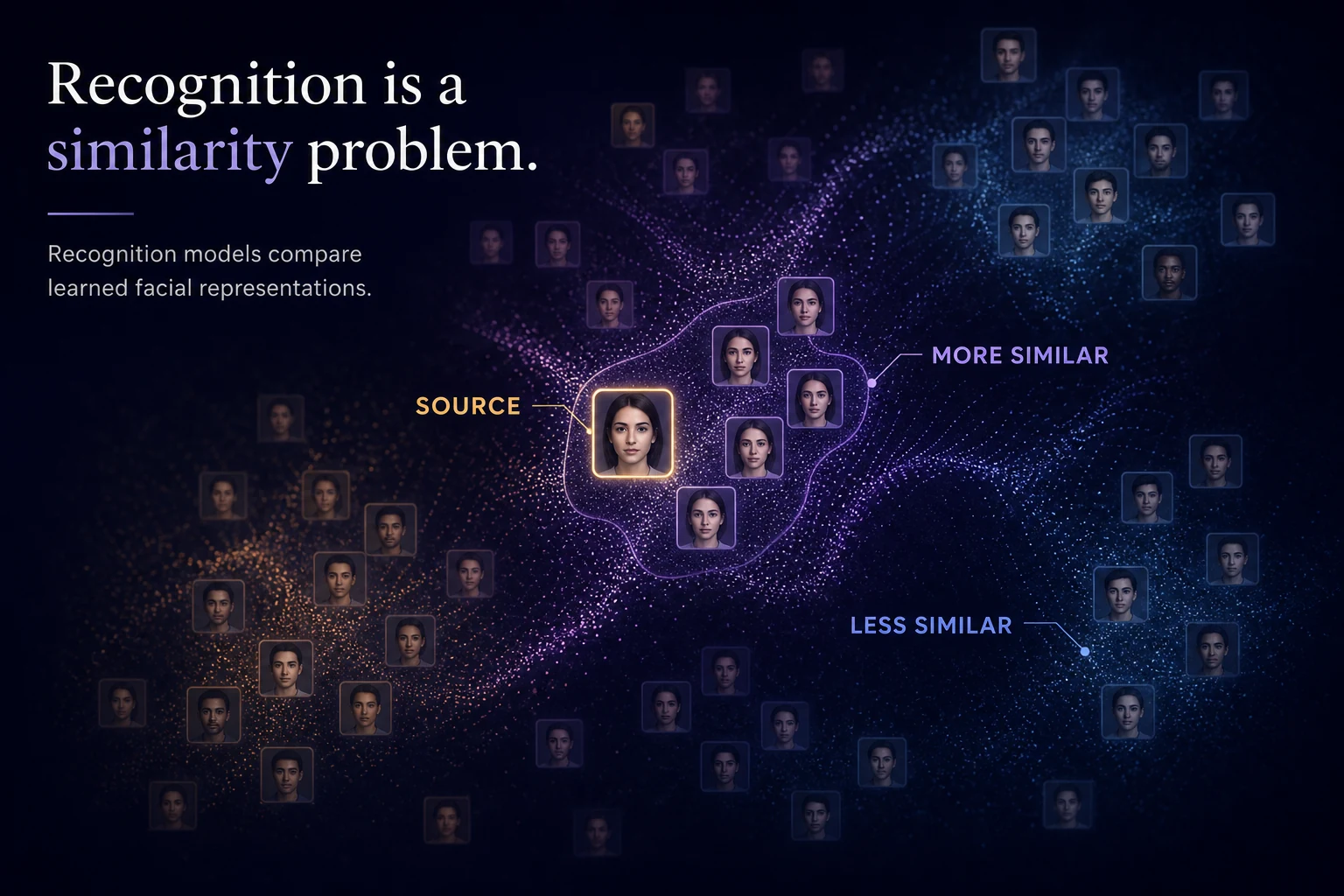
A modern recognition model can transform a face into a numerical embedding: a point in a learned multidimensional space. Faces represented closer together in that space can be treated as more visually similar according to that model.
For the full pipeline, see How Reverse Face Search Works.
5. The decision threshold
This is one of the most important concepts in the article.
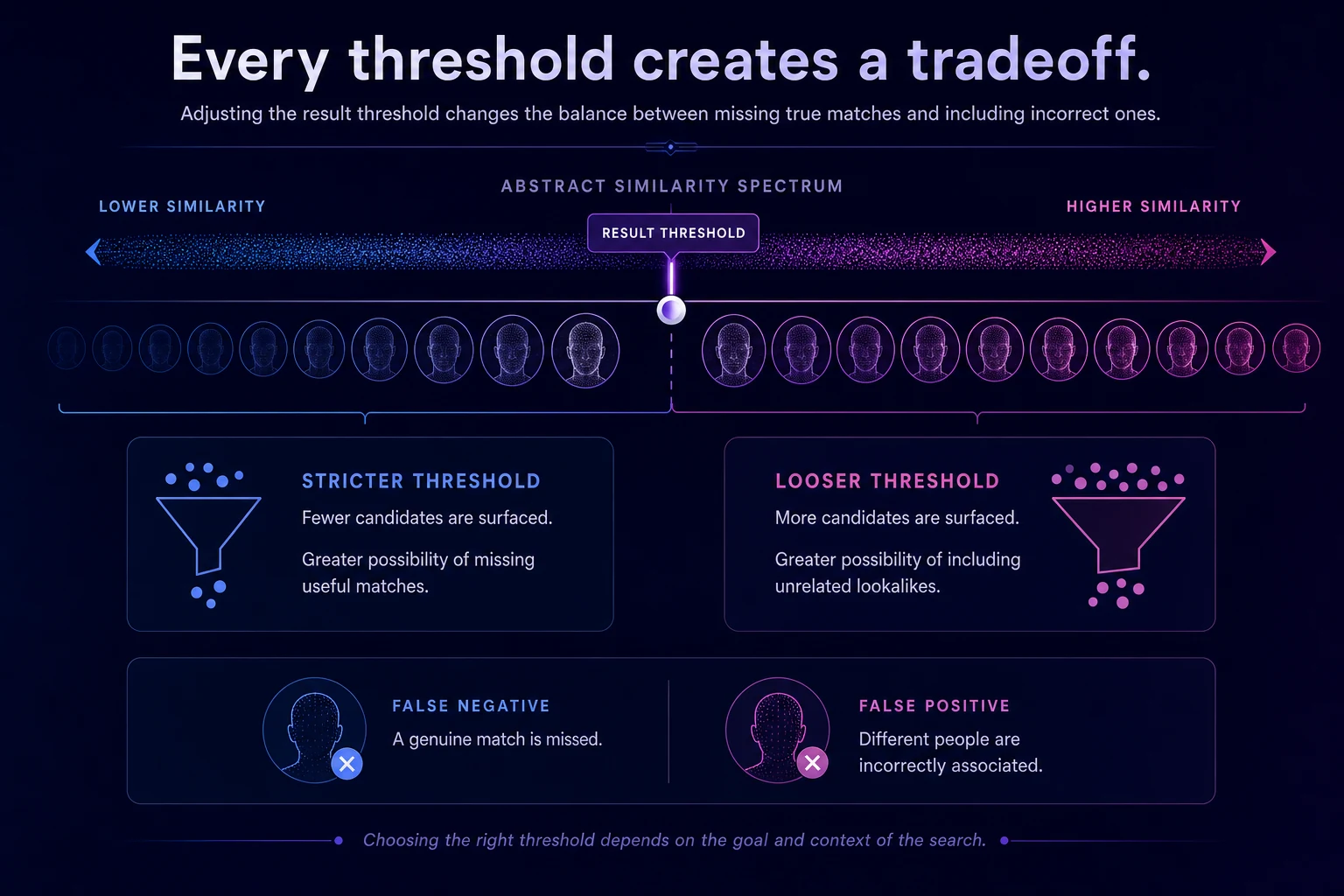
Facial similarity isn't simply MATCH or NOT MATCH.
The model produces a comparison value.
The system then has to decide:
How similar does a candidate need to be before we show it?
That decision creates a tradeoff.
Set the threshold too strict and you can miss genuine matches.
Set it too loose and you can return more unrelated lookalikes.
Those correspond broadly to two types of error:
False negative — Two photographs actually depict the same person, but the system fails to associate them strongly enough.
False positive — Two photographs depict different people, but the system associates them incorrectly.
NIST evaluates both false-negative and false-positive behavior and emphasizes that error rates depend on the algorithm and operating conditions.
6. The size of the search matters
Here's something users almost never think about.
Finding the closest face among 100 candidates is not the same problem as searching among millions of faces.
As the candidate population grows, there are more opportunities for unrelated people to resemble the source face.
That's why large-scale identification/search should not be thought about exactly like simple one-to-one verification.
NIST research has shown that estimates of face-recognition performance can depend on the composition of the non-match population being searched.
For reverse face search, that reinforces why ranking and careful human review matter.
7. Demographics can affect performance
Facial-recognition performance has historically varied across demographic groups, and the size and direction of those differences depend heavily on the algorithm and conditions being tested.
NIST has documented demographic differentials in false-positive and false-negative rates across algorithms, including variation associated with age, sex, and race — see the FRTE demographics summary. It also emphasizes that poor image quality can interact with these effects.
Modern systems have improved substantially, and the differences are not identical across every algorithm.
But it's another reason not to describe facial recognition with one universal accuracy percentage.
And then there's search coverage
Now the giant elephant in the room.
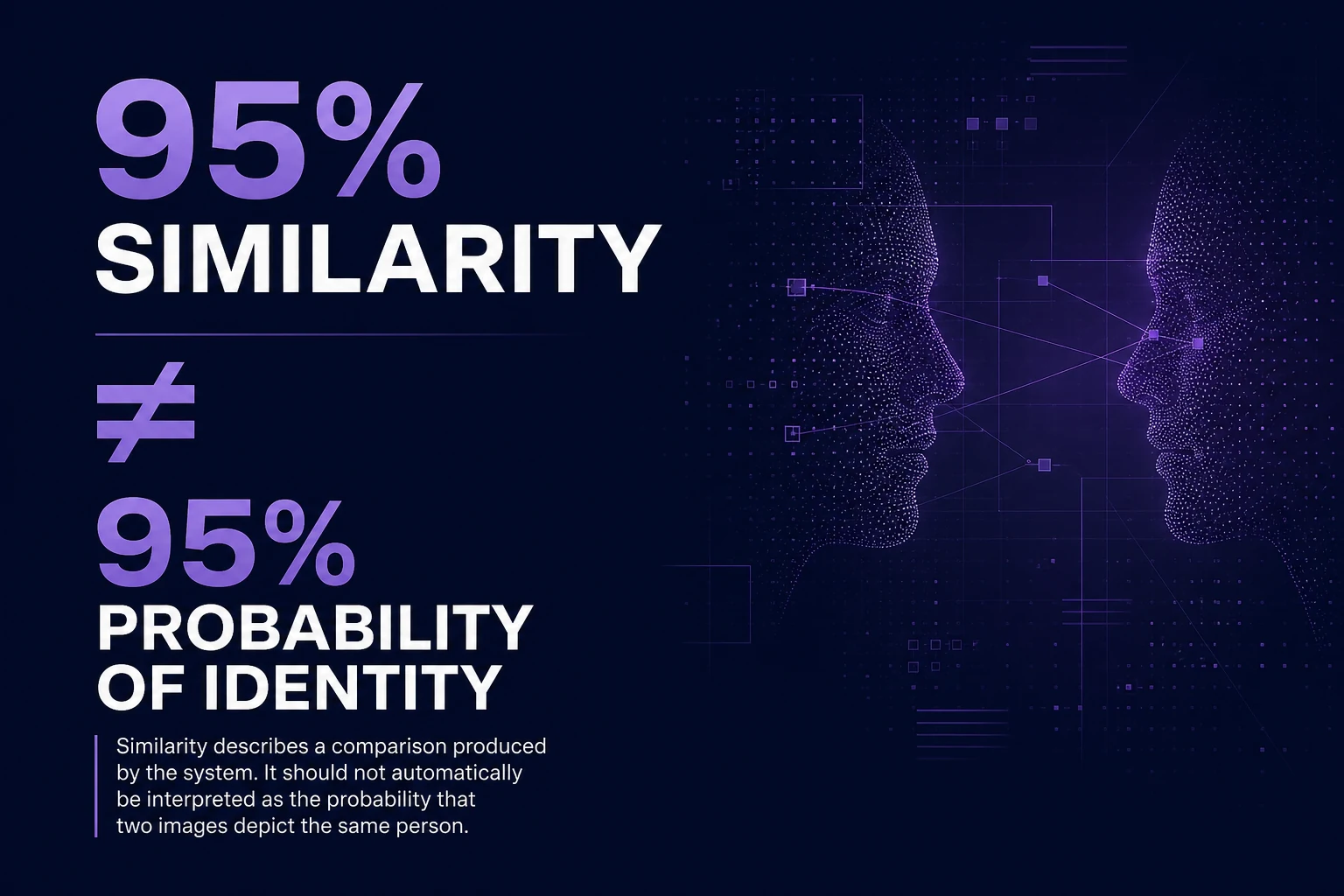
Imagine the facial-recognition component were magically 100% perfect.
You upload your face.
Somewhere online is another photograph of you.
But that photograph isn't in the searchable resources available to the system.
Result?
Nothing.
Recognition accuracy didn't fail.
Retrieval coverage did.
This distinction is enormously important for reverse face search. (No Face Search Results? What That Actually Means.)
Why a similarity percentage isn't an identity probability
This deserves a substantial section because it's one of the easiest numbers to misunderstand.
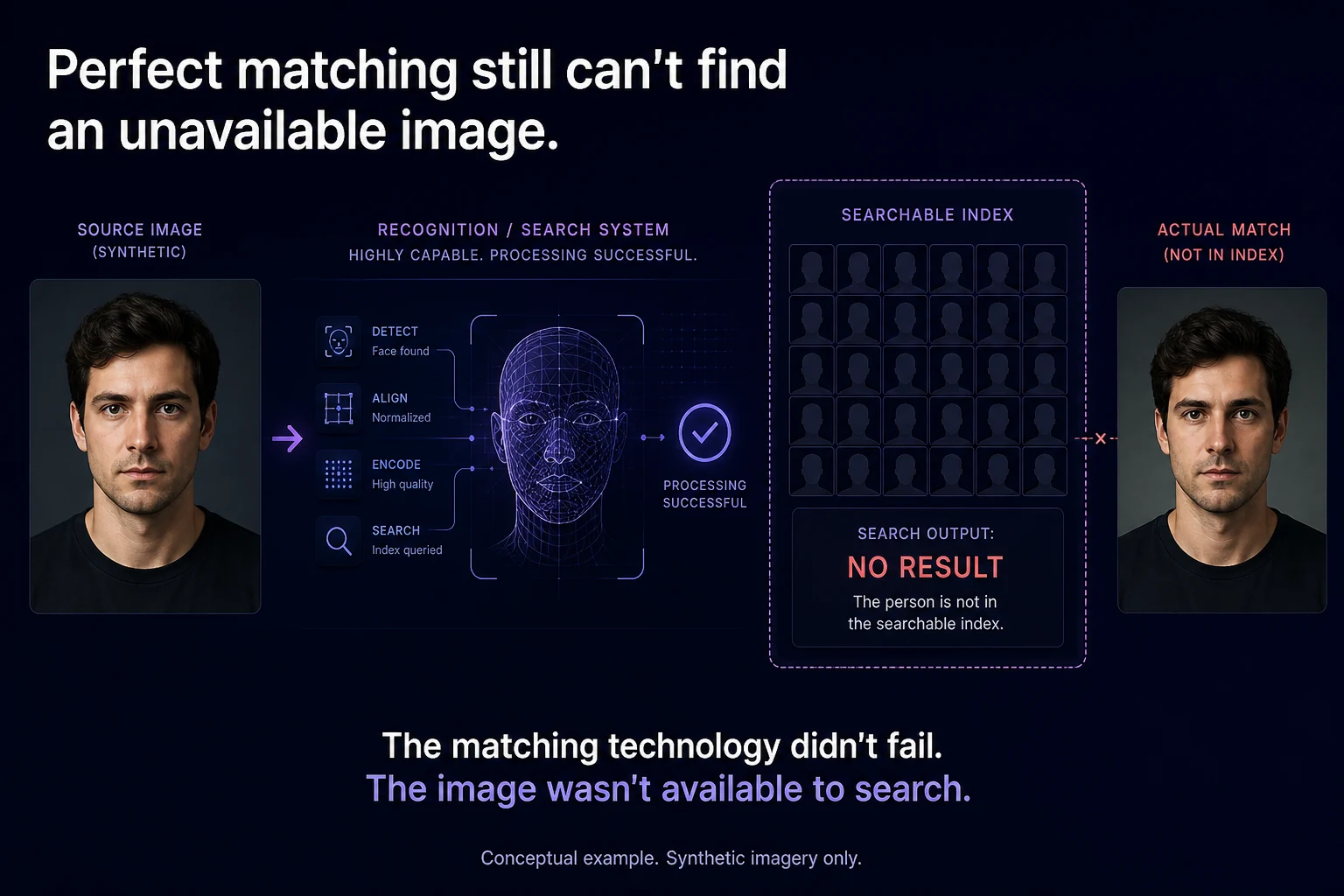
Suppose an interface displays:
95% similarity
A user may instinctively read that as:
There is a 95% probability this is the same person.
Those statements are not automatically equivalent.
A similarity score describes how the system compares the facial representations according to its own scoring method.
A probability of identity would require something different: a properly calibrated statistical interpretation accounting for the model, relevant population, operating conditions, and other assumptions.
So unless a system specifically establishes and validates such a probability:
Similarity score ≠ probability of identity.
Why two face-search engines can disagree
You upload the exact same photo to two services.
Engine A finds five interesting results.
Engine B finds none.
Does that prove Engine A has better facial recognition?
No.
Possible explanations include:
different recognition models;
different searchable indexes;
different similarity thresholds;
different ranking systems;
different crawler coverage;
different image-processing pipelines;
different filtering rules.
The relevant photograph may simply exist in one provider's index and not the other's.
That's why evaluating reverse face search from one or two anecdotal searches can be misleading. For a practical comparison of tools, see Best Reverse Face Search Engines in 2026.
So how accurate is it?
Here's where we finally answer the title directly.
Modern face recognition can be highly accurate under favorable conditions.
But:
Reverse face search does not have one universal accuracy percentage.
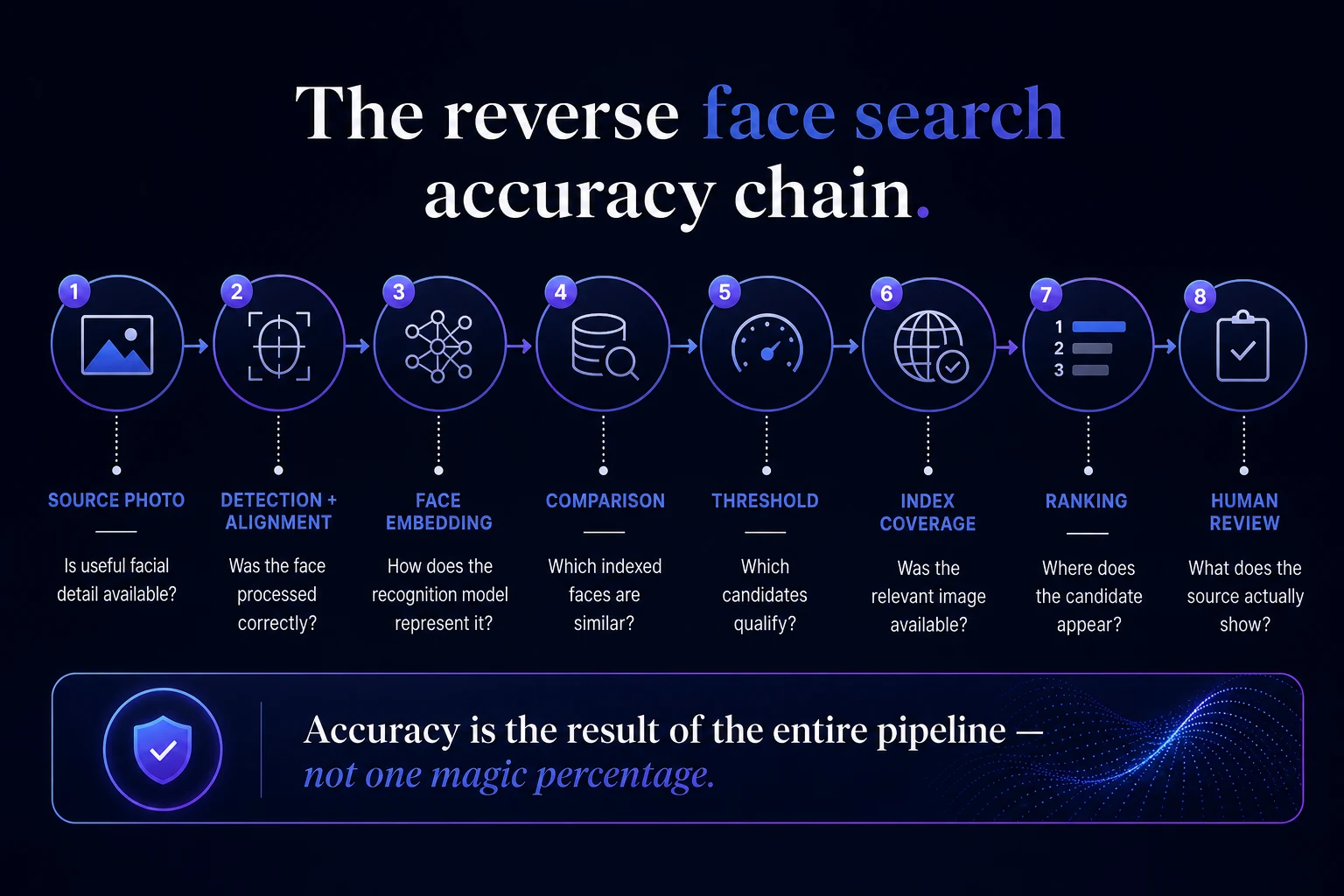
Its real-world usefulness depends on a chain:
Source-photo quality
Face detection and alignment
Recognition model
Similarity comparison
Threshold
Search index coverage
Ranking
Human interpretation
A weakness anywhere in that chain can affect the result.
What a face-search result actually means
A strong result means the search system found a face it considers visually similar enough to surface according to its comparison and ranking process.
It does not, by itself, establish:
identity;
authenticity;
ownership of an account;
intent;
trustworthiness;
or personal safety.
Likewise, no results do not establish that no relevant photographs exist.
This gives us the two rules that apply across reverse face search:
A result isn't proof of identity.
and
No result isn't proof of absence.
That's essentially CatchAFace's philosophy condensed into two sentences — discovery, not identity verification. (Face search vs. reverse image search.)
Accuracy needs context
Facial recognition has become extraordinarily capable, but “How accurate is it?” is incomplete without asking:
Which model?
Which photographs?
Which threshold?
Which candidate population?
Which search index?
Which operating conditions?
That's why CatchAFace treats reverse face search as discovery rather than identity verification.
A useful result gives you something to investigate.
It doesn't make the investigation unnecessary.
Related Articles
Guides
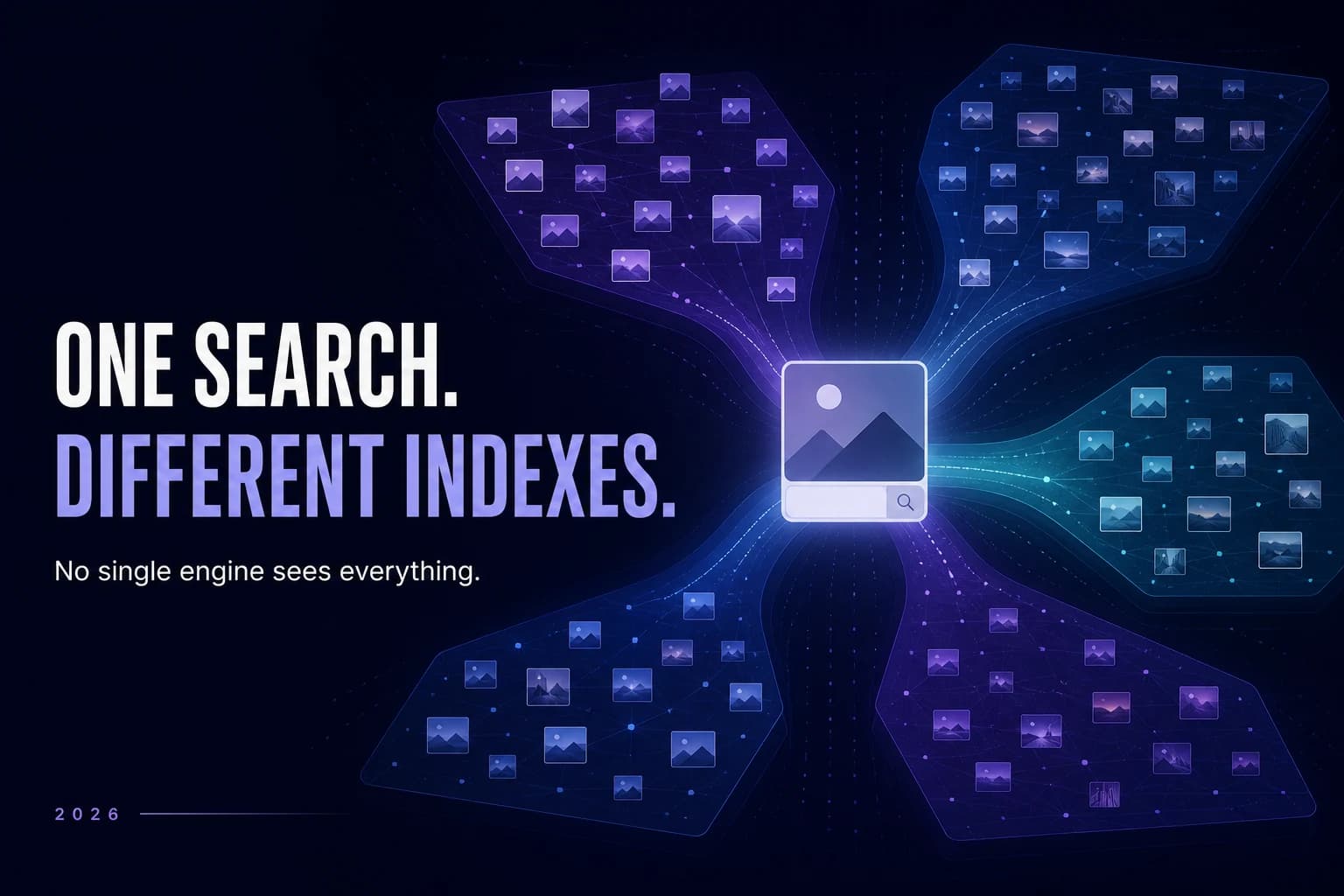
Best Reverse Face Search Engines in 2026
Reverse face search engines don't all search the same sources or present results the same way. Here's how the major face-search options in 2026 differ — and which type of tool may fit what you're trying to find.
9 min read
Face Search
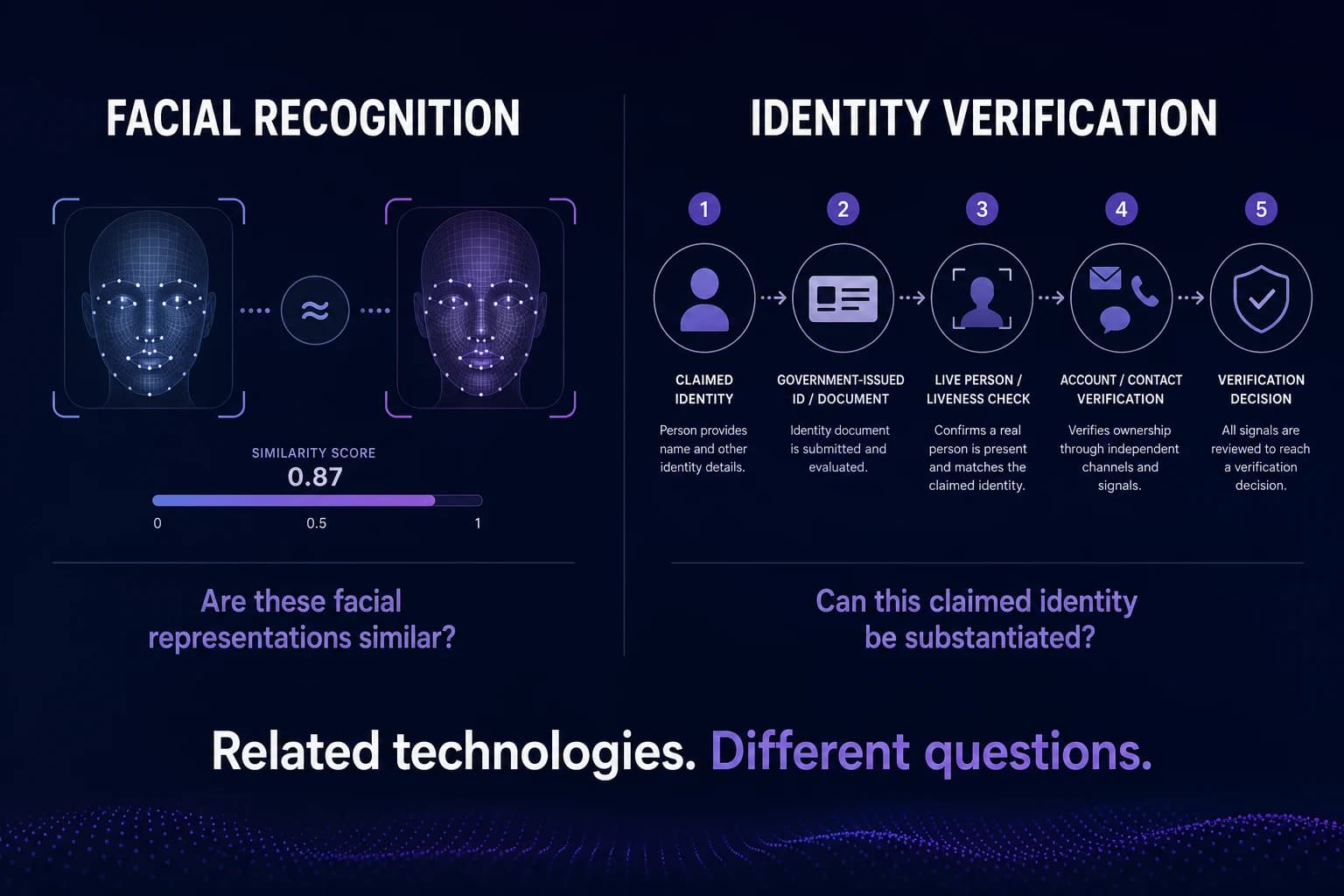
Facial Recognition vs. Identity Verification
Facial recognition and identity verification are often treated as the same thing. They aren't. Learn what each technology actually does — and why a face match by itself does not confirm identity.
6 min read
Face Search
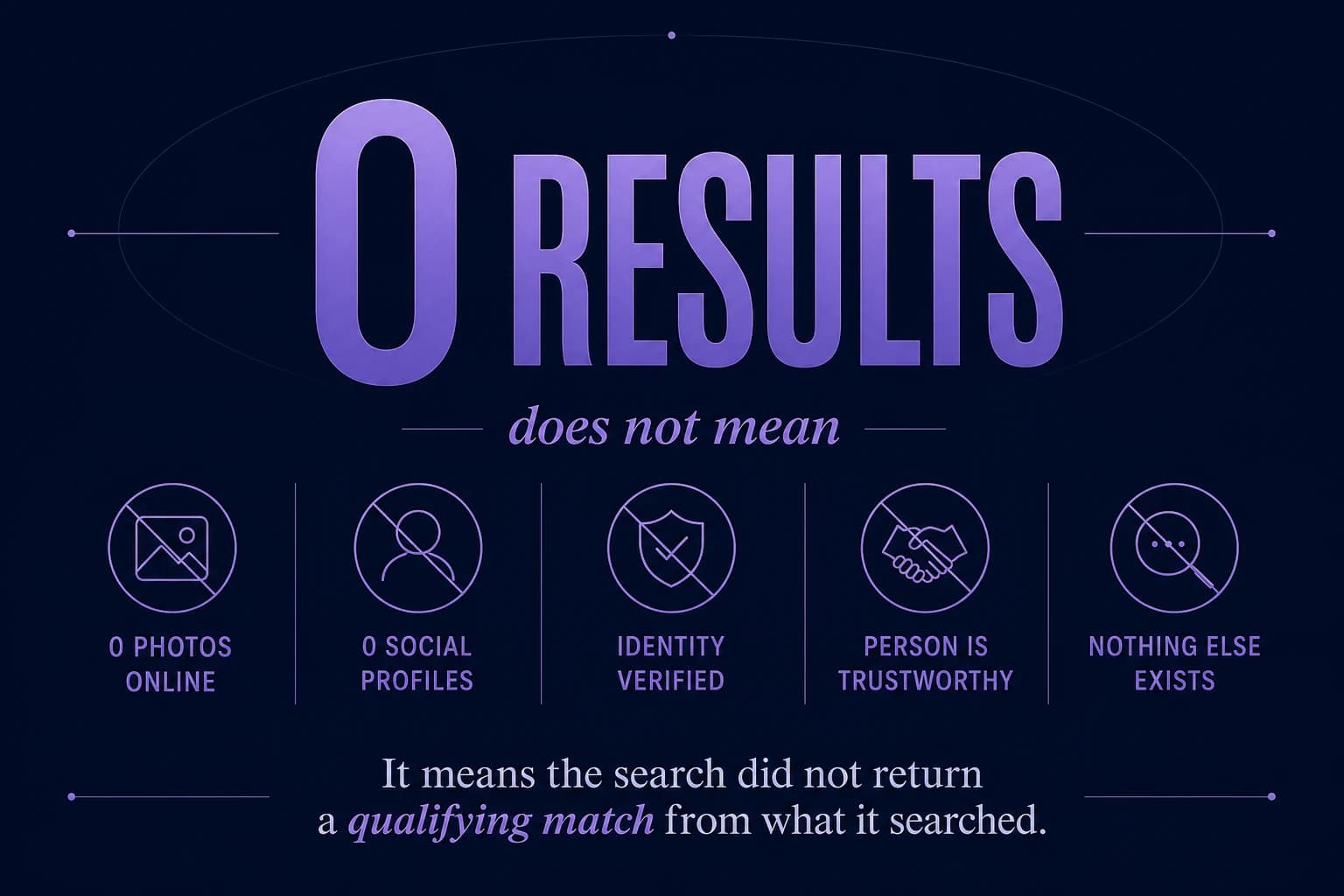
No Face Search Results? What That Actually Means
A reverse face search returned nothing. Does that mean the person has no other photos online? Not necessarily. Here's what zero results actually tells you — and what it doesn't.
7 min read